 kalko
How do you tell what a company is building before it announces it?
Read three public sources together: job posts, filings and what leaders say in public. A job post shows what a team is hiring to build, and a filing shows what worries the company. When two sources point at the same project, you have a dated reason to reach out, or a clear reason to skip.
Key takeaways
- US public companies list their main risks in Item 1A of the annual 10-K (SEC).
- Most 8-K events, such as a new senior officer, are filed within four business days (Investor.gov).
- Twilio's 10-Q for the quarter to 30 June 2026 says its revenue comes mainly from usage-based fees (SEC EDGAR).
- A live Twilio job post, checked 28 October 2026, says its billing is going through a transformational journey (Twilio careers page).
What public data shows a company's plans before it announces them?
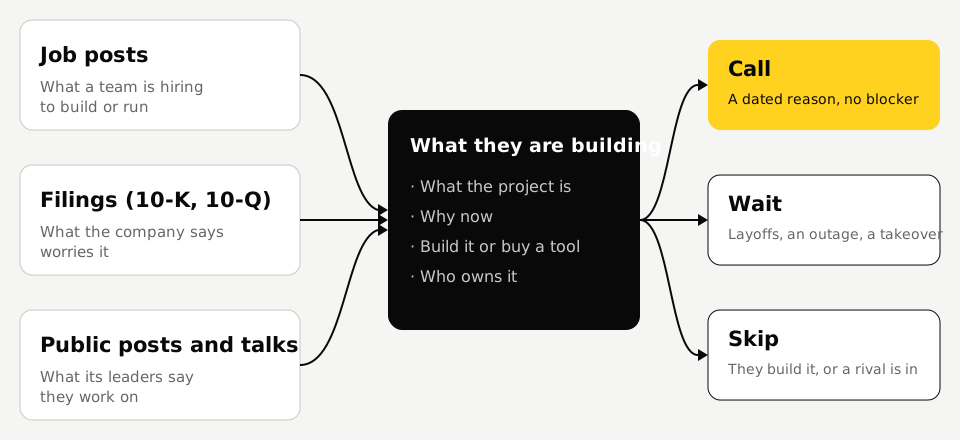
Three sources, read together, show most projects before the press release.
- Job posts: what a team is hiring to build or run, in the team's own words.
- Filings (10-K, 10-Q, 8-K): what the company says worries it, and what it plans to change.
- Public posts and talks: what its leaders say they work on this year.
What do job posts reveal that press releases do not?
A press release says what shipped. A job post says what a team plans to build next. Read every post for five things.
| Question | What to look for in the post |
|---|---|
| What is the project? | The system or change the role exists for, in the post's own words |
| Why now? | A migration, a new market, a deadline, or a first hire for a new team |
| Build or buy? | “Design and build our own” means build. “Administer” or “evaluate tools” means buy or run |
| What do they use today? | Every tool the post names. A named tool is the incumbent |
| Who owns it? | The team or the role the post reports to |
How do you read one job post, line by line?
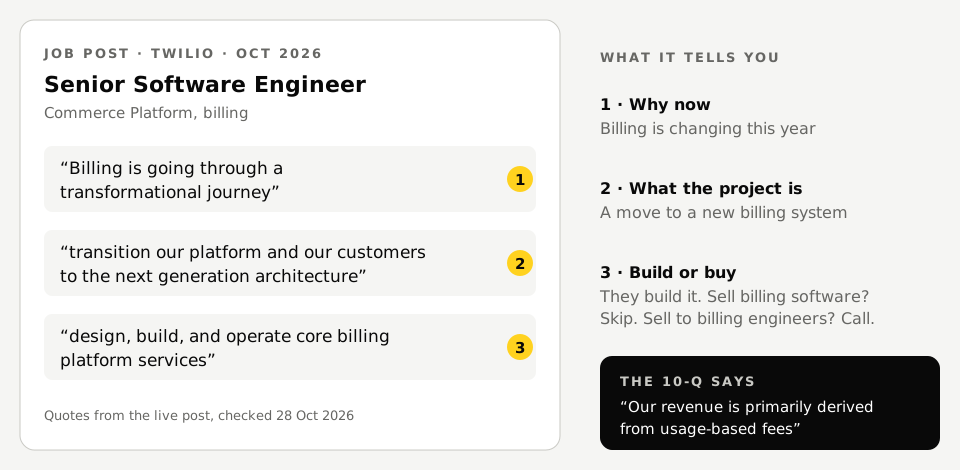
Take one live Twilio billing post, checked in October 2026. Three lines answer three of the five questions.
Notice what the post does not say. It names no budget, no vendor and no deadline. A second source fills that gap.
Where do plans show up in 10-Ks, 10-Qs and 8-Ks?
- 10-K, Item 1A: the risks the company names itself. Skip the lines every filing has.
- 10-K and 10-Q, MD&A: what the company plans to change, such as systems, costs or prices.
- 8-K: big events that move fast, such as a new executive or a deal.
- SEC filings for sales prospecting: Which filing to read for which signal, and how to get alerts.
Why read job posts and filings together?
One source gives you a hint. Two sources that point at the same project give you a reason to reach out.
Twilio's 10-Q says its revenue comes mainly from usage-based fees. Its billing post says the billing platform is moving to a new architecture. A second post asks for automated data reconciliation checks.
Read together, the three lines point at one project: a billing rebuild. The filing never says so. The match is strong when both sources name the same system, and weak when they only share an area.
How do you tell a real project from routine hiring?
A real project leaves more than one trace. Routine hiring replaces a role that already exists, with generic duties and no project named.
- Several open roles describe the same system.
- A post is the first hire for a new team or a new country.
- The post names a migration, a launch or a deadline.
- A filing or a leader's post names the same work.
- Job posts that signal a new product or market: The post types that come before a launch, with the roles to watch.
When do you call, wait or skip?
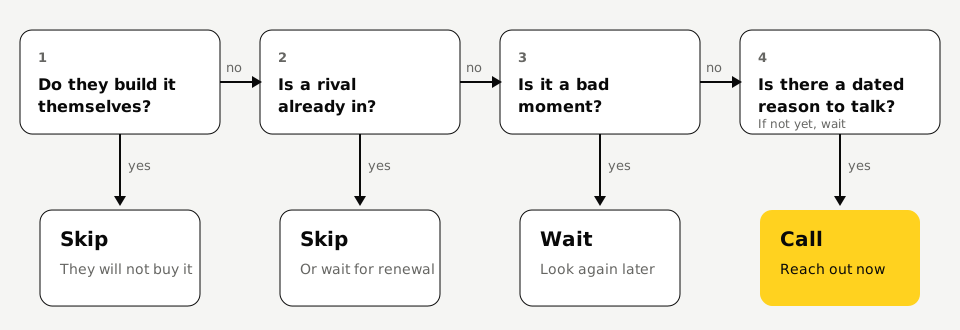
Ask four questions in order. The first yes decides.
| Live post, checked 28 Oct 2026 | What it says | If you sell | Decision |
|---|---|---|---|
| GitLab, Dedicated Infrastructure | “We build and operate the large-scale distributed infrastructure” | Infrastructure tooling | Skip: the team builds its own |
| Figma, Business Systems | “Design, build, and operate integrations… using MuleSoft” | An integration platform | Skip: a rival tool is already in. Or wait for its renewal |
| Twilio, billing | “Billing is going through a transformational journey” | Tools for billing engineers | Call: a dated reason, nothing in the way |
How do you tell a real B2B buying signal from noise?
Funding news and a general headline happen to buyers and non-buyers alike. Use them to word a message, not to pick an account.
- It names a problem you solve, in the company's own words.
- It has a date, and the date is recent.
- A second source agrees.
- The post is still open today. Recheck it before you use it.
What can public signals not tell you?
Treat each read as a reason to ask about their plans. Their answer confirms it.
- The budget, and who signs.
- Whether a vendor is already chosen behind closed doors.
- Private companies file nothing with the SEC, so job posts and leaders' posts carry the read.
How do you do this for every account?
The method above works for one account in one sitting. A market has hundreds, and posts open and close every week.
Kalko runs this read on every account in your market. Each one gets what it is building, who owns it, and call, wait or skip, with a dated source on each line. The trial comes with 200 credits.
- Free Claude skills: Job post decoder and call, wait or skip, to run this read on one account in Claude.
- How Kalko checks a claim: The checks every claim passes before it reaches you.
Questions people ask
Is it fine to use job posts and filings for sales research?
Job posts and SEC filings are public documents that companies publish for anyone to read. Stay with company facts and public statements, and keep personal data out.
Does this work for private companies?
Yes, with two sources instead of three. Private companies file no 10-K, so read their job posts and what their leaders say in public.
How far ahead of a launch do job posts appear?
It varies by company and role. Hiring for a new team usually starts before the launch. Treat a cluster of posts as early notice, and confirm it with a second source.
What is the skip rule?
Skip an account when it builds the thing itself or already runs a rival. Wait when the moment is bad. Call only with a dated reason and nothing in the way.
Sources
- SEC Investor Bulletin: How to Read a 10-K, checked October 28, 2026
- Investor.gov: How to Read an 8-K, checked October 28, 2026
- Twilio Form 10-Q for the quarter ended 30 June 2026 (SEC EDGAR), checked October 28, 2026
- Twilio job post: Senior Software Engineer, billing, checked October 28, 2026
- Twilio job post: Senior Analytics Engineer, checked October 28, 2026
- Figma job post: Data & Integration Engineer, Business Systems, checked October 28, 2026
- GitLab job post: Engineering Manager, Dedicated Infrastructure, checked October 28, 2026
Job posts that signal a new product
Which roles show up before a launch or a new market.
→SEC filings for sales prospecting
Which filing to read for which signal.
→How to prioritize target accounts
Rank accounts by fit, need and timing.
→Hiring signals vs intent data
Which buying signal to trust, and when.
→Fewer accounts. Better won.
Bring your ICP. We will return a sourced market brief your team can inspect, approve, and act on.