 kalko
How do you decide which accounts to call, wait on or skip?
Skip an account when it builds the thing itself, is committed to a rival, or does not fit. Wait when the moment is wrong, such as layoffs, an outage, a takeover or a departing budget owner, and set a recheck date. Call when a dated public reason appears and nothing on the skip or wait list is true.
Key takeaways
- Dropbox filed an 8-K on 28 October 2026 that announced a cut of about 9% of its global workforce (SEC EDGAR).
- Varonis signed a merger agreement on 15 October 2026 and expects the deal to close in the first half of 2027 (SEC EDGAR).
- Most 8-K events are filed within four business days of the event (Investor.gov).
- A live Duolingo job post, checked 28 October 2026, says the team runs an in-house Experiment Platform (Duolingo careers page).
What do call, wait and skip mean for an account?
Each verdict is a decision with a reason and a date. Write both down, so the account comes back at the right time.
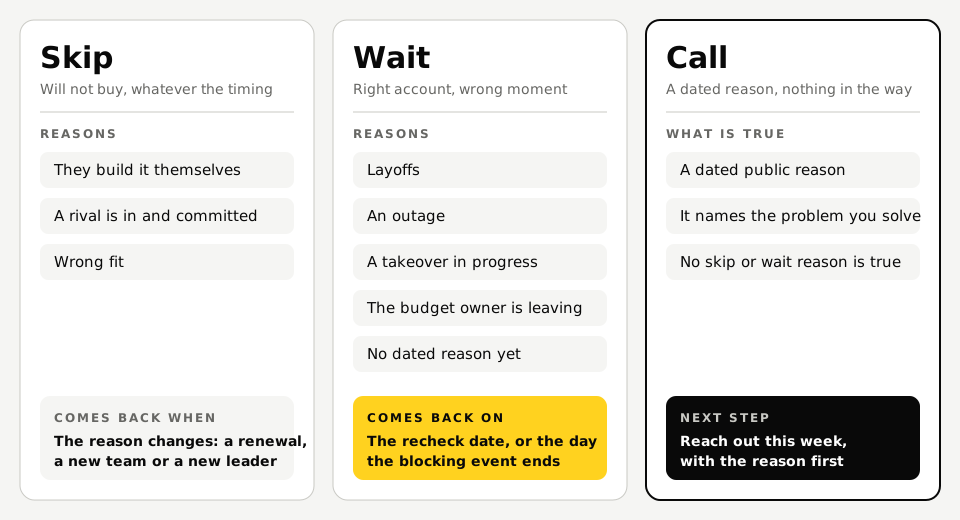
| Verdict | What is true | What you do | When you look again |
|---|---|---|---|
| Call | A dated public reason ties the account to the problem you solve, and nothing blocks a talk | Reach out this week, with the reason in the first line | After a reply, or when the sequence ends |
| Wait | The account fits, but the moment is wrong | Park it with the reason and a recheck date | On the recheck date, or when the blocking event ends |
| Skip | The account will not buy what you sell, whatever the timing | Take it off the list and write down why | When the skip reason changes, such as a renewal or a new team |
When do you skip an account?
Skip when the account will not buy, whatever the timing. There are three kinds of skip, and each has a sign you can check.
Duolingo posted a Data Platform manager role on 19 October 2026. The manager will run “our in-house Experiment Platform”. If you sell A/B testing software, skip Duolingo.
MongoDB posted a finance technology lead role on 19 October 2026. It calls the NetSuite environment “the financial system of record”. A rival ERP seller skips MongoDB.
A seller of close or tax tools reads further. The same post asks the team to evaluate “when to configure, customize, or buy”.
A skip ends when its reason ends. Note the reason, so a renewal, a new team or a new leader brings the account back.
- They build it themselves. A job post says the team runs or builds its own version of what you sell.
- A rival is in and committed. A post names the tool you replace as the system the team owns.
- Wrong fit. The account is too small to have the problem, in the wrong industry, or in a market you do not serve.
When do you wait instead of skip?
Wait when the account fits but the moment is wrong. Each kind of wait leaves a public trace, and each ends with an event you can see.
Dropbox filed an 8-K on 28 October 2026. It announced “a reduction of its global workforce by approximately 9%”. The same filing says its Chief Technology Officer leaves on 18 November 2026.
Varonis agreed to be acquired by Proofpoint on 15 October 2026. Its 8-K says “The Merger is expected to close in the first half of 2027.” Use that date as the recheck date.
GitHub's status page logged a critical incident on 28 October 2026, “Disruption with some Copilot services”. It was resolved the same day, with a note. “A detailed root cause analysis will be shared as soon as it is available.”
| Wait reason | Where it shows up | What ends the wait |
|---|---|---|
| Layoffs | 8-K Item 2.05, a state WARN notice, or a company post | The cut is done, and the team posts new roles |
| An outage | The company's public status page | The incident is resolved, and the root cause is published |
| A takeover in progress | 8-K Item 1.01, with a merger agreement | The deal closes or ends, and the owner sets new plans |
| The budget owner is leaving | 8-K Item 5.02, or a company post | A successor is named |
| No dated reason yet | Nothing new in posts, filings or leaders' public posts | A new post, filing or public statement names your problem |
- SEC filings for sales prospecting: Which 8-K items to watch, and how to get alerts.
How does a wait turn into a call?
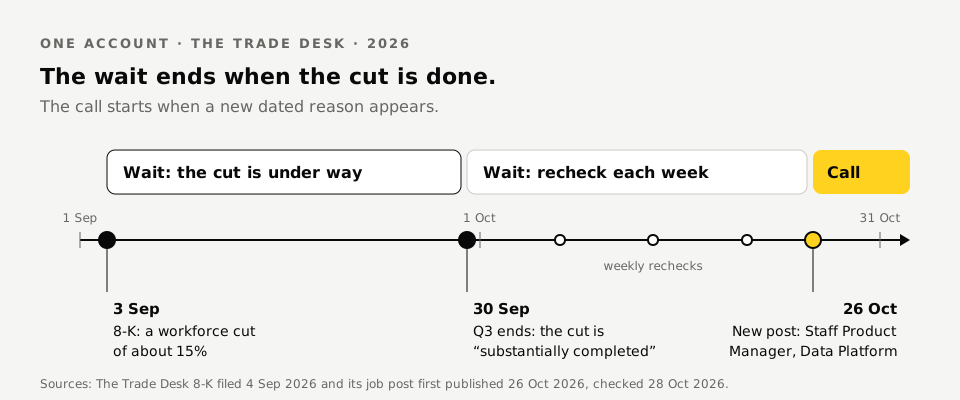
A wait ends in two steps. The blocking event ends, and then a new dated reason appears. One step alone keeps the account parked.
The Trade Desk filed an 8-K on 4 September 2026. It cut its workforce by about 15%, “substantially completed during the third quarter of 2026”.
On 26 October 2026 it posted a Staff Product Manager role for its data platform. The post says “AI and agents are also expanding who uses data and what they can do with it.”
If you sell data platform tooling, that post turns the wait into a call. The cut is done, and a new role names the work.
How often do you recheck a parked account?
Recheck on the date the wait reason gives you. Scan the whole list once a week for new posts and filings.
Most 8-K events are filed within four business days of the event (Investor.gov). Put the recheck date in your CRM, next to the reason.
| Verdict and reason | Recheck on |
|---|---|
| Wait: layoffs | The date the filing says the cut is done, then each week for new roles in the team you sell to |
| Wait: an outage | The day the root cause analysis is published |
| Wait: a takeover in progress | The expected close in the 8-K, and the day the closing is reported |
| Wait: the budget owner is leaving | The departure date, then each week until a successor is named |
| Wait: no dated reason yet | Every week, with the rest of the list |
| Skip | Each quarter, or when a renewal or a new team appears |
What do you say when you call?
Open with the dated reason, in their own words, and ask about their plan.
For The Trade Desk, the opener reads like this. “I read your 26 October post for a data platform product lead. It says AI and agents are expanding who uses data. Which teams does the platform serve first?”
- Name the source and its date in the first line.
- Quote one line from it.
- Ask one question about their plan. Pitch nothing yet.
- Leave the wait reason out. Do not mention the layoff, the outage or the deal.
Which timing mistakes lose the account?
- Calling on funding news. A round says the company has money. It does not say what it will buy, or when.
- Calling during a layoff. The team is shrinking, and the budget owner is busy with the cut.
- Pitching an incident tool in the middle of an outage. Wait for the root cause analysis, then use it as the reason.
- Pitching a long contract during a takeover. Recheck on the expected close date in the 8-K.
- Waiting with no date. A wait without a recheck date turns into a skip by accident.
- Skipping on a missing fact. No sign either way means wait, with no dated reason yet.
- Keeping a skip forever. Recheck every skip each quarter.
Which signals show an account is ready to buy right now?
Leading signals come before a purchase. Lagging signals report what already happened, so they make poor reasons to call.
| Signal | Type | What it tells you |
|---|---|---|
| A job post for a new team or a new system | Leading | Work is starting, and the tools are still open |
| A filing that names a planned change | Leading | The company committed to the change in public |
| A funding round | Lagging | Money arrived. It names no project |
| A press release about a launch | Lagging | The work shipped, so the tools are in place |
- Hiring signals vs intent data: Which buying signal to trust, and when.
- How to tell what a company is building: Read job posts and filings together to find the dated reason.
How do you run call, wait or skip for every account?
By hand, the method works for one list in one sitting. A market has hundreds of accounts, and every wait has its own recheck date.
Kalko runs this read on every account in your market and re-scores each one every week. Each account gets call, wait or skip, who owns the work, and a dated source on each line.
When Kalko finds a reason to skip an account, it says so and links the source. The trial comes with 200 credits.
- Free Claude skills: Call, wait or skip, to run this decision on one account in Claude.
- How Kalko checks a claim: The checks every claim passes before it reaches you.
Questions people ask
Which accounts do SDRs skip?
Accounts that build the product themselves, accounts committed to a rival, and accounts outside your fit. Write the reason down, so the account comes back when the reason changes.
What is the difference between wait and skip?
Wait means the account fits but the moment is wrong, so it gets a recheck date. Skip means it will not buy what you sell until something changes.
Do you call an account during layoffs?
No. Wait until the filing says the cut is done and the team posts new roles. Then call with the new role as the reason.
Is funding news a reason to call?
Use it to word a message, never to pick the account. A round happens to buyers and non-buyers alike.
How long do you wait on an account that is being acquired?
Use the expected close in the merger 8-K as the recheck date. Varonis, for example, expects its deal to close in the first half of 2027.
Sources
- Dropbox Form 8-K filed 28 October 2026 (SEC EDGAR), checked October 28, 2026
- Varonis Systems Form 8-K filed 15 October 2026 (SEC EDGAR), checked October 28, 2026
- The Trade Desk Form 8-K filed 4 September 2026 (SEC EDGAR), checked October 28, 2026
- The Trade Desk job post: Staff Product Manager, Data Platform, checked October 28, 2026
- Duolingo job post: Senior Engineering Manager, Data Platform, checked October 28, 2026
- MongoDB job post: Senior Lead, Product Management (finance technology), checked October 28, 2026
- GitHub Status: Disruption with some Copilot services, 28 October 2026, checked October 28, 2026
- Investor.gov: How to Read an 8-K, checked October 28, 2026
- US Department of Labor: WARN Act, checked October 28, 2026
How to tell what a company is building
The first handbook: read job posts, filings and public posts together.
→How to prioritize target accounts
Rank accounts by fit, need and timing.
→SEC filings for sales prospecting
Which filing to read for which signal.
→Trigger events in sales
What counts as a buying trigger, with examples.
→Fewer accounts. Better won.
Bring your ICP. We will return a sourced market brief your team can inspect, approve, and act on.