 kalko
How do you find the buying triggers for your product?
Start from what you sell and who buys it, then list the events that create that problem by a date. Keep a trigger only when a buyer says in public that the event came first. Then find its date and the cheapest public place to watch for it.
Key takeaways
- Valley sent one LinkedIn campaign to two lists. A cold list got 5.7% replies and a signal list got 46.3% (self-reported, YouTube).
- Gojiberry's founder reported 45% LinkedIn replies on intent signals in November 2025, and about 17% cold in February 2026 (self-reported, X).
- EU member states had to bring the Pay Transparency Directive into national law by 7 June 2026 (EUR-Lex, Article 34).
- Atlassian says its Data Center products reach end of life on 28 March 2029 (Atlassian).
What is a buying trigger?
A buying trigger is an event that creates a problem your product solves, often by a date. A good trigger passes three tests.
- It creates the problem you solve, at the company where it happens.
- It has a date, or a short window after the event.
- A buyer says in public that the event came before the purchase.
- What is a trigger event in sales?: The definition, with common examples.
Why is your best trigger not on your website?
Your website lists what the product does. A case study or a review names the event that started the search.
A Vanta case study says Snowfire had seven deals stalled pending a SOC 2 Type II report. The trigger was a customer demand, with a deal attached.
A Sage case study says Greenidge outgrew QuickBooks and Excel after its public listing and a multi-state expansion. The trigger was growth, plus two dated company events.
Both triggers come from the buyer side. You find them in reviews and case studies, in the buyer's words.
Do messages sent on a buying signal get more replies?
The public numbers compare a list built on a signal with a cold list. Both tests below are self-reported by the vendor that ran them.
In both tests the change was who got the message. Valley built its signal list from website visitors and post engagement.
Those signals reach people who already know you. A trigger also reaches accounts that have the problem and have never heard of you.
- Valley, May 2026: the same LinkedIn campaign got 5.7% replies and 2 opportunities on 2,300 cold prospects. It got 46.3% and 56 opportunities on 1,690 people with a signal.
- Gojiberry: 45% LinkedIn replies in November 2025 on intent signals. In February 2026 it reported about 17% before, and three times the replies after.
What kinds of buying triggers are there?
There are two kinds. Buying states are conditions that push a company to buy. Company events are dated changes that create a new need.
- Growth outgrows the tool: volume doubles and the spreadsheet that worked at half the size breaks.
- A vendor shuts down or reprices: the current tool reaches end of life, is acquired or costs more.
- Fragmented, manual systems: staff copy data between tools that do not connect.
- A regulation with a date: a new rule that applies to every company in a segment.
- A contract renewal: a contract end date, a tender or a request for proposal.
- A new owner with a mandate: a new leader, or a role posted to evaluate, select and implement a tool.
- Company events: a merger or acquisition, an expansion to new sites or countries, an audit, or a platform migration.
How do you pick the triggers for your product?
Work from your product outward. The steps take one sitting for one product.
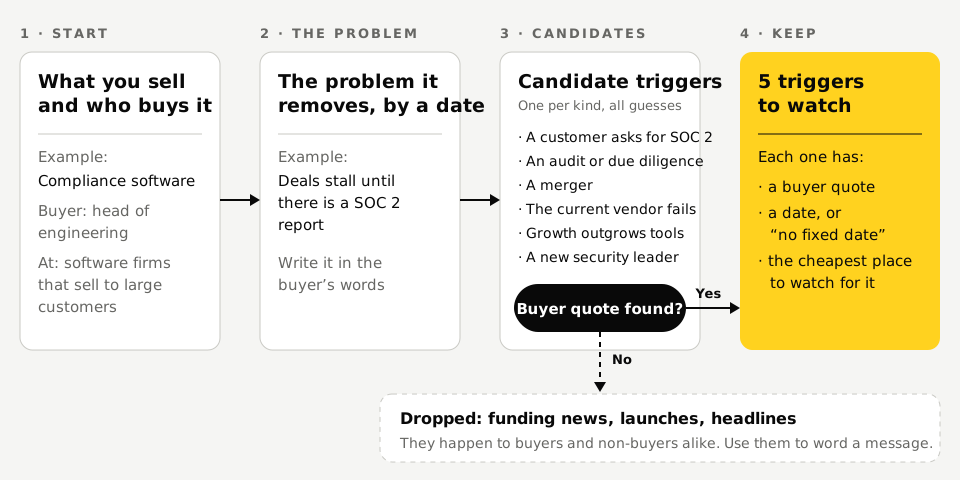
- Write one line each: what you sell, who buys it, and at which companies.
- Write the problem your product removes, in the buyer's words.
- Go through each kind of trigger. Ask if the event creates that problem, by a date.
- Keep the five that create the problem most directly. Mark each one as a guess.
- Look for one buyer quote per trigger. A guess with a quote becomes a trigger.
- Add the date and the cheapest place to watch for it.
How do you prove a trigger came first?
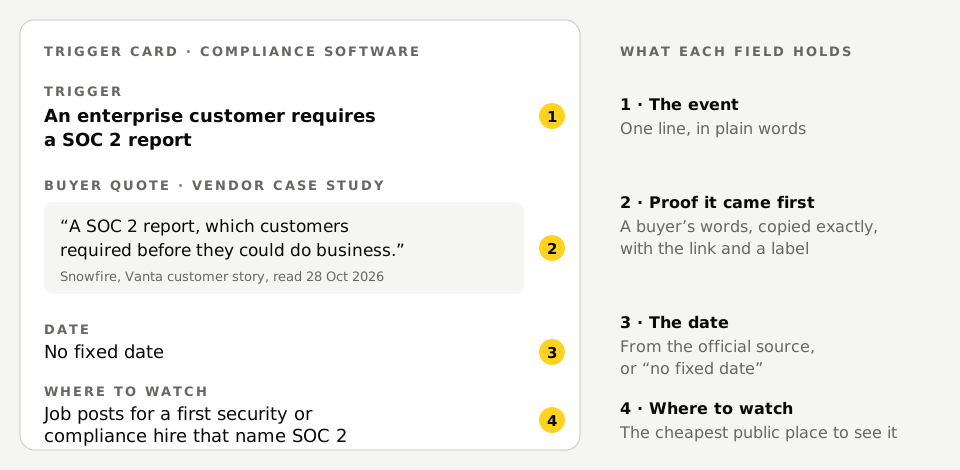
Keep a trigger only when a buyer says in public that the event came before they bought. Look in three places.
Search with the event in the query, for example “switched from” plus your category plus “after our merger”. Copy the key words exactly, with the link.
A review in the buyer's own words is stronger than a vendor case study. If you find no quote, write “no buyer quote yet” and treat the trigger as a guess.
- Review sites, where staff describe why they switched tools.
- Case studies, including your rivals' case studies. Label them as vendor case studies, because the vendor wrote them.
- Forum and community posts, where buyers ask for help after an event.
How do you find the date of a trigger?
A date tells you who must act and by when. Three kinds of trigger carry an official date.
If you sell pay or HR software, that one date applies to every EU employer the rule covers.
Take every date from the official source. Dates move, so check the regulator or the vendor before you use one.
Some member states set later national dates for the pay directive, for example 1 January 2027 (Morgan Lewis, 8 June 2026). Check the country, then the account.
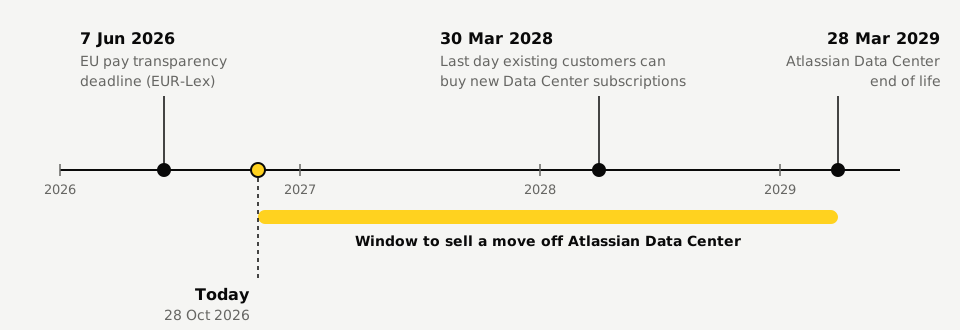
When no official date exists, write “no fixed date”. The date of the event itself then sets a short window.
- Regulations: Article 34 of the EU Pay Transparency Directive gave member states until “7 June 2026” to bring national laws into force.
- Vendor end of life: Atlassian says Data Center products reach end of life on 28 March 2029. Existing customers can buy new subscriptions until 30 March 2028.
- Contract renewals: public tenders and procurement notices show the end date of a contract.
Where is the cheapest place to watch each trigger?
Most triggers leave a public trace that costs nothing to read. Start with the free source for each one.
| Trigger | Cheapest place to watch | What to look for |
|---|---|---|
| Growth outgrows the tool | Job posts | Several openings for the same manual or operations role |
| A vendor shuts down or reprices | The vendor's end-of-life or pricing page, review sites | An end date, a price change, an acquisition |
| Fragmented, manual systems | Job posts, staff reviews | “Reconcile data across”, “manual”, “spreadsheets” |
| A regulation with a date | The regulator's own site | The date the rule applies, and who it covers |
| A contract renewal | Public procurement portals, job posts | A tender, or a post that names the incumbent tool |
| A new owner with a mandate | Job boards such as Greenhouse and Lever, company news | “Evaluate, select and implement”, or a new leader |
| Merger or acquisition | Press releases, filings | An announced deal, then integration work |
| Expansion | Job posts in new locations, press | First hires in a new country or site |
| Audit or inspection | Regulator databases, filings | A finding, a review or an inspection date |
| Platform migration | Job posts, engineering blogs | “Migrate from”, “replatform”, a named old and new system |
- How to tell what a company is building: Read job posts, filings and public posts together for one account.
Which news do you ignore when you pick triggers?
Some events look like triggers but happen to buyers and non-buyers alike. Use them to word a message. Pick the account on a trigger.
- Funding rounds: a raise rarely names the problem you solve.
- Product launches and general headlines: good openers, weak reasons to call.
- Topic reading data: it shows interest in a topic, without the event behind it.
- Layoffs, restructuring and bankruptcy: these pause buying. Read them as a reason to wait.
- Hiring signals vs intent data: Which buying signal to trust, and when.
How do you watch your triggers for every account?
The method in this handbook works for five triggers and a few accounts. A market has hundreds of accounts, and job posts and filings change every week.
Kalko reads job posts, filings and buyer posts for every account in your market, and re-scores each one every week. Each account gets what it is working on and who owns it.
Each account also gets call, wait or skip, with a dated source on each line. The trial comes with 200 credits.
- Free trigger-map skill: Your domain in, five ranked triggers out, each with a date and a place to watch, in Claude.
- How Kalko checks a claim: The checks every claim passes before it reaches you.
Questions people ask
What is the difference between a buying trigger and a buying signal?
A trigger is the event that creates the need, such as a merger or a new rule. A signal is the public trace that shows it, such as a job post or a filing.
Is a funding round a good buying trigger?
Rarely on its own. A raise happens to buyers and non-buyers alike. Use it to time or word a message after a real trigger picks the account.
How many triggers do you watch?
Start with five. Add a trigger only when a buyer quote proves it came first.
Do vendor case studies count as proof?
Yes, with a label. The vendor wrote the page, so a review in the buyer's own words is stronger. Quote the exact words and keep the link.
How often do you recheck a trigger?
Recheck the source each time you use it. Job posts close and official dates move.
Sources
- Valley on YouTube: If I Started LinkedIn Outreach in 2026, I'd Do This (self-reported test), checked October 28, 2026
- Gojiberry founder on X, 7 February 2026: about 17% replies cold, three times the replies on buying intent (self-reported), checked October 28, 2026
- Gojiberry founder on X, 9 November 2025: 45% replies on intent signals (self-reported), checked October 28, 2026
- Vanta customer story: Snowfire (vendor case study), checked October 28, 2026
- Sage Intacct success story: Greenidge Generation Holdings (vendor case study), checked October 28, 2026
- EUR-Lex: Directive (EU) 2023/970 on pay transparency, Article 34, checked October 28, 2026
- Morgan Lewis: EU Pay Transparency Directive, the deadline for transposition has passed (8 June 2026), checked October 28, 2026
- Atlassian: Data Center end of life, checked October 28, 2026
- Kalko free skill: trigger map, checked October 28, 2026
What are sales signals?
The definition, with examples and where each one is published.
→How to tell what a company is building
The handbook on reading one account from public sources.
→How to prioritize target accounts
Rank accounts by fit, need and timing.
→How to use intent data
Where topic reading data helps, and where it misleads.
→Fewer accounts. Better won.
Bring your ICP. We will return a sourced market brief your team can inspect, approve, and act on.